Global Water Security
 A
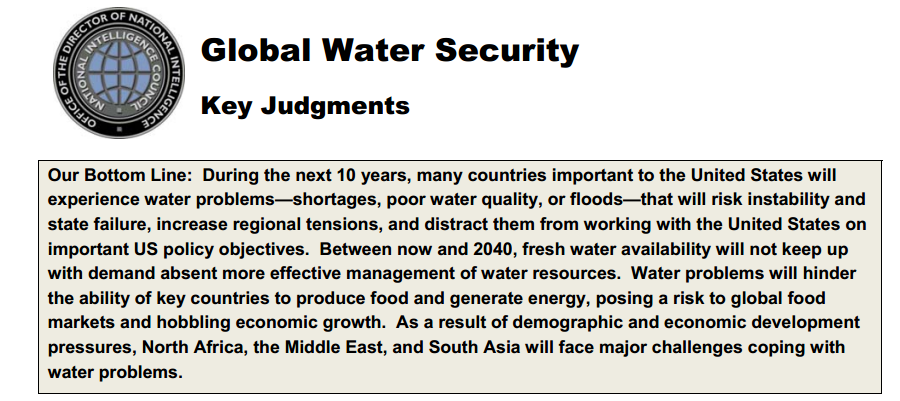
-We assess that during the next 10 years, water problems will contribute to instability in states important to US national security interests. Water shortages, poor water quality, and floods by themselves are unlikely to result in state failure. However, water problems—when combined with poverty, social tensions, environmental degradation, ineffectual leadership, and weak political institutions—contribute to social disruptions that can result in state failure.We have moderate confidence in our judgment as we have reliable open source reporting on water pricing and infrastructure investments and reliable but incomplete all-source reporting on water quality.
The lack of adequate water will be a destabilizing factor in some countries because they do not have the financial resources ortechnical ability to solve their internal water problems. In addition, some states are further stressed by a heavy dependency on river water controlled by upstream nations with unresolved water-sharing issues. Wealthier developing countries probably will experience increasing water-related social disruptions but are capable of addressing water problems without risk of state failure
B. We assess that a water-related state-onstate conflict is unlikely during the next 10 years. Historically, water tensions have led to more water-sharing agreements than violent conflicts. However, we judge that as water shortages become more acute beyond the next 10 years, water in shared basins will increasingly be used as leverage; the use of water as a weapon or to further terrorist objectives also will become more likely beyond 10 years. We have high confidence in our judgments because there are excellent allsource reports on future water shortages and a well-established pattern of water problems aggravating regional tensions.
We assess that during the next 10 years a number of states will exert leverage over their neighbors to preserve their water interests. This leverage will be applied in international forums and also include pressuring investors, nongovernmental organizations, and donor countries to support or halt water infrastructure projects.
We assess that states will also use their inherent ability to construct and support major water projects to obtain regional influence or preserve their water interests. In addition, some nonstate actors (terrorists or extremists) almost certainly will target vulnerable water infrastructure to achieve their objectives.
C-We judge that during the next 10 years the depletion of groundwater supplies in some agricultural areas—owing to poor management—will pose a risk to both national and global food markets.We have high confidence in our judgment as we have numerous reliable open source projections on agricultural production and water depletion trends.
- Many countries have over-pumped their groundwater to satisfy growing food demand. Depleted and degraded groundwater can threaten food security and thereby risk social disruption. When water available for agriculture is insufficient, agricultural workers lose their jobs and fewer crops are grown. As a result, there is a strong correlation between water available for agriculture and national GDP.
- Over the long term, without mitigation actions (e.g., drip irrigation, reduction of distortive electricity-for-water pump subsidies, improved use of agricultural technology, and better food distribution networks), the exhaustion of groundwater sources will cause food production to decline and food demand will have to be satisfied through increasingly stressed global markets.
D-We assess that from now through 2040 water shortages and pollution probably will harm the economic performance of important trading partners. Economic output will suffer if countries do not have sufficient clean water supplies to generate electrical power or to maintain and expand manufacturing and resource extraction. Hydropower is an important source of electricity in developing countries—more than 15 developing countries generate 80 percent or more of their electrical power from hydropower—and demand for water to support all forms of electricity production and industrial processes is increasing. We have moderate-to-high confidence in our judgment as we see no breakthrough technology that will reduce the industrial demand for water.
- In some countries, water shortages are already having an impact on power generation. Frequent droughts in other countries will undermine their long-term plans to increase current hydropower capacity.
E-We judge that, from now through 2040, improved water management (e.g., pricing, allocations, and “virtual water” trade) and investments in water-related sectors (e.g., agriculture, power, and water treatment) will afford the best solutions for water problems.
Because agriculture uses approximately 70 percent of the global fresh water supply, the greatest potential for relief from water scarcity will be through technology that reduces the amount of water needed for agriculture.We have high confidence in this judgment because of the body of open source reporting indicating effective water management will be the most effective approach to mitigate water-related social tensions.
- Simple and inexpensive water management improvements in agriculture, including improved irrigation practices and land-leveling (to obtain an even distribution of water), are often the most straightforward way to compensate for increased demand and stretch existing water supplies.
Scope Note
Global Water Security
This is an IC-coordinated paper.
This report—requested by the Department of State—is designed to answer the question: How will water problems (shortages, poor water quality, or floods) impact US national security interests over the next 30 years? We selected 2040 as the endpoint of our research to consider longer-term impacts from growing populations, climate change, and continued economic development. However, we sometimes cite specific time frames (e.g., 2030, 2025) when reporting is based on these dates. For the Key Judgments, we emphasize impacts that will occur within the next 10 years.
We provide an introductory discussion of the globalwater picture, but we do not do a comprehensive analysis of the entire global water landscape. For the core classified analysis—a National Intelligence
Estimate—we focused on a finite number of states that are strategically important to the United States and transboundary issues from a selected set of water basins (Nile, Tigris-Euphrates, Mekong, Jordan, Indus, Brahmaputra, and Amu Darya). We judge that these examples are sufficient to illustrate the intersections between water challenges and US national security.
Assumptions:We assume that water management technologies will mature along present rates and that no far-reaching improvements will develop and be deployed over the next 30 years. In addition, for several states, we assume that present water policies—pricing and investments in infrastructure—are unlikely to change significantly. Cultural norms often drive water policies and will continue to do so despite recent political upheavals. Finally, we assume that states with a large and growing economic capacity continue to make infrastructure investments and apply technologies to address their water challenges.
This effort relied on previously published Intelligence Community (IC) products, peer-reviewed research, and consultations with outside experts. The Defense Intelligence Agency (DIA) was the principal drafter with contributions from NGA, CIA, State/INR, and DOE.


.png)


.jpg)


Yorumlarınızı Bizimle Paylaşın
Sadece üyelerimiz yorum yapabilir, hemen ücretsiz üye olmak için Tıklayın