

COP31 Leaders’ Summit: Mitigation In, Adaptation Out
- 15.11.2026
- Author:Dursun Yıldız
- (0) Comment
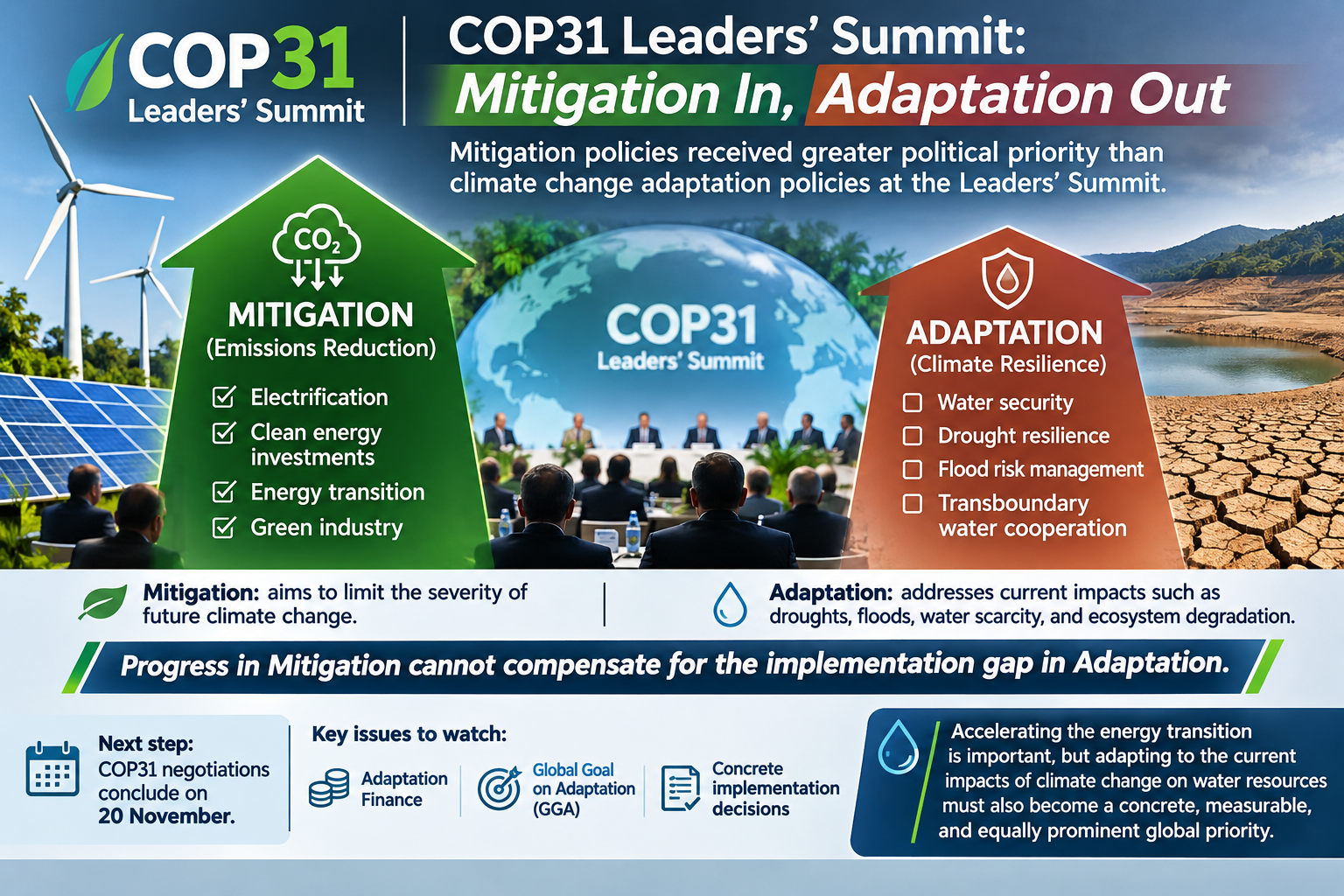
Mitigation policies received greater political priority than climate change adaptation policies at the Leaders’ Summit.
Dursun Yıldız
President, Hydropolitics Association (SPD)
14 November 2026
The emphasis placed on electrification, clean energy investments, and energy transition at the COP31 Leaders’ Summit primarily reflects an approach focused on reducing greenhouse gas emissions.
Of the four high-level roundtable discussions, two focused on clean energy transition and green industrial investments, one addressed the implementation of the Paris Agreement and climate finance, and one dealt with urban resilience and climate adaptation. Special events were also organized on early warning systems and climate resilience.
Mitigation aims to limit the severity of future climate change, while Adaptation addresses the impacts already being experienced, including droughts, floods, water scarcity, and ecosystem degradation.
For example, increasing electrification by 2035 may contribute to reducing climate risks in the long term. However, this objective alone cannot ensure water security in a river basin already experiencing water scarcity. Achieving water security requires revising water allocation policies, improving irrigation efficiency, implementing drought management plans, and strengthening water infrastructure.
Therefore, progress in Mitigation cannot compensate for the implementation gap in Adaptation.
The prominence of energy transition and electrification at the COP31 Leaders’ Summit demonstrates that Mitigation continues to enjoy greater political visibility in global climate policy. However, in the face of the existing and increasingly severe impacts of climate change, Adaptation policies must also be supported by equally concrete targets, financing mechanisms, and implementation commitments.
As is often observed at COP summits, the technical feasibility of a particular solution, or the political prominence given to a technical agenda, does not necessarily mean that the resulting transition is socially just.
For this reason, it is essential to place Water Security, Drought Resilience, Flood Risk Management, and Transboundary Water Cooperation at the center of climate adaptation policies.
In conclusion: The opening days of COP31 and the Leaders’ Summit suggest that Mitigation has received greater political visibility than Adaptation. However, a comprehensive assessment of the actual balance of priorities will require examining the outcomes of the negotiations scheduled to conclude on 20 November, particularly those concerning Adaptation Finance, the Global Goal on Adaptation (GGA), and concrete implementation decisions.
Accelerating the energy transition at COP31 is important, but adapting to the current impacts of climate change on water resources must also become a concrete, measurable, and equally prominent global priority.

.png)


.png)


.jpg)


Share Your Comments
Only members can comment, Click here to sign up for free right now