

Earth’s water cycle grows more erratic as long-term reserves keep shrinking, WMO warns
- 22.09.2026
- Author:admin
- (0) Comment
Earth’s water cycle grows more erratic as long-term reserves keep shrinking, WMO warns
River flows were among the driest in 35 years in 2025, while glaciers, groundwater and terrestrial water storage kept declining across much of the world.

Written byCristina Novo
17 September 2026
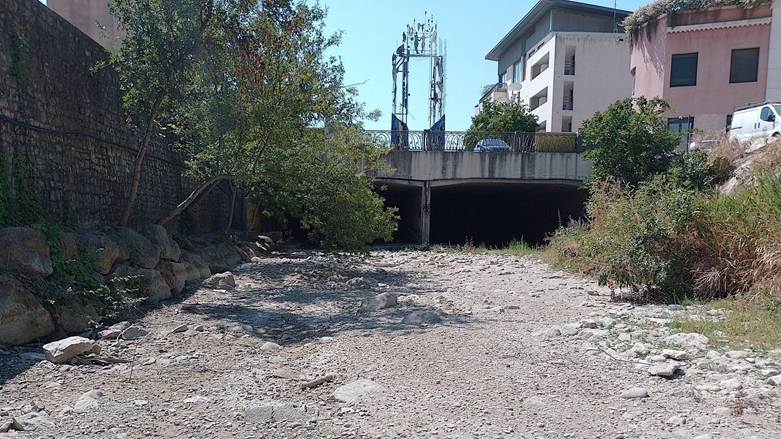 The Huveaune river bed gone dry during the 2022 heatwave. Côte d’Azur, France. Credit: Ianaré Sévi via Wikimedia Commons.
Share
The world’s water cycle is swinging more sharply between extremes, and the reserves that normally cushion against those swings are running down. That is the central finding of the World Meteorological Organization’s State of Global Water Resources 2025 report, its fifth annual assessment of the global hydrological cycle, which this year also includes a five year synthesis covering 2021 to 2025.
WMO Secretary-General Celeste Saulo frames the finding around a distinction between the fast moving parts of the water cycle, such as precipitation, river flow and soil moisture, which respond to weather within days or weeks, and the slow reserves, groundwater, glaciers and seasonal snowpack, which build up or deplete over years to decades. She describes those slow reserves as the planet’s savings account, the buffer that stops a single bad year turning into a full blown crisis. That account, the report’s findings show, is being drawn down faster than it is being replenished.
Key findings at a glance
- Driest river discharge in 35 years. Around 36% of the world’s catchment area ran drier than normal in 2025, against 21% that ran wetter.
- Seven years of abnormal flows. Basins with normal river discharge have made up a clear minority of global basin area every year since 2019.
- A decade of shrinking storage. Terrestrial water storage, the sum of groundwater, soil moisture, snow, ice, lakes and rivers, has declined since 2014-2016.
- Fourth straight year of glacier loss. Every major glaciated region recorded a net loss in 2025, for a cumulative 1,400 gigatonnes since 2023.
- Asia and Africa hit hardest, seen least. The two regions account for most water related deaths but supply only around 7% of river discharge stations in the report.
A cycle swinging between extremes
2025 was one of the warmest years on record globally, with a weak La Niña emerging late in the year after mostly neutral conditions, alongside a predominantly negative Indian Ocean Dipole that reduced rainfall over East Africa while boosting it over Indonesia and Australia. Against that backdrop, river discharge told a stark story: around 36% of the world’s catchment area ran drier than normal in 2025 and only 21% wetter, making it one of the driest years for global river flow since 1991. It was also the seventh consecutive year in which basins with normal discharge made up a clear minority of global basin area, between 34% and 38%, well short of the 1991-2020 average of 46%.
Reservoirs and lakes largely mirrored that geography, with inflows and storage down across the Middle East, Eastern Europe, Central Asia and parts of the Americas, while African lakes and reservoirs, including Malawi, Chad, Victoria and Tanganyika, held much above normal levels. Underneath these year to year swings sits a longer running decline: terrestrial water storage, the combined total of water held in groundwater, soil, snow, ice, lakes and rivers, has been falling since 2014-2016, with the area affected by deficits continuing to grow rather than stabilise a decade on.
Five years of mounting losses
The slow reserves show the clearest long-term signal in the report. Glaciers lost mass in every one of the last three reporting years, for a cumulative global loss of 1,400 gigatonnes of water since 2023; 2025 was the fourth consecutive year in which every major glaciated region recorded a net loss, and smaller glacier regions such as the European Alps, Scandinavia and the Caucasus may already have passed what scientists call peak water, the point at which melt driven runoff begins a permanent decline. Groundwater followed a similar trajectory: persistent deficits ran through 2022 to 2025 across parts of the Americas, Europe, the Middle East, India, southern Africa and Australia, and in 2025 some 65% of monitored wells worldwide sat outside their historical norm, with the balance shifting further toward deficit than in 2024.
These slow trends are converging with a rise in disruptive events. Asia and Africa together accounted for nearly half of all recorded water related disasters over the past five years and more than 80% of associated deaths, with Nigeria hit by major flooding for two consecutive years and the Democratic Republic of the Congo for three. In 2025 alone, compound cyclones and intense monsoon rainfall killed more than 3,600 people across South and South-East Asia, while Hurricane Melissa cost Jamaica losses equivalent to 41% of its GDP and Cyclone Ditwah cost Sri Lanka around 4% of its GDP. Severe, prolonged drought also gripped Eastern Europe, the Mediterranean, the Middle East and the Greater Horn of Africa, prompting a national emergency in Somalia.
|
Event, 2025 |
Region |
Impact |
|
Compound cyclones and monsoon rainfall |
South and South-East Asia |
More than 3,600 deaths |
|
Hurricane Melissa |
Jamaica |
Losses equal to 41% of GDP |
|
Cyclone Ditwah |
Sri Lanka |
Losses equal to 4% of GDP |
|
Prolonged drought |
Greater Horn of Africa |
National emergency in Somalia |
Watching the places most at risk least closely
The report’s own data reveal an uncomfortable gap. Since its first edition in 2021, the network behind it has grown substantially, with country coverage expanding more than sevenfold for river discharge and more than fivefold for groundwater, and the number of hydrological variables tracked rising from three to 15. Yet Africa and Asia, the two regions the report identifies as most affected by floods, droughts and associated deaths, still supply only around 7% of the river discharge stations included, leaving the areas under the greatest strain among the least visible in the data. Newer tools are starting to help close that gap; this edition includes, for the first time, observations from the NASA-CNES SWOT satellite mission, and draws on 13 global hydrological models as a substantial input, with modelled river discharge agreeing with observations in 63% of the basins where validation was possible.
Water respects no borders
Celeste Saulo, WMO Secretary-General
WMO’s response is to press its Members for more consistent, timely data sharing through systems such as the WMO Hydrological Observing System and the Global Hydrological Status and Outlook System, both of which depend on national services exchanging observations under the WMO Unified Data Policy. As Saulo put it, water “respects no borders,” since a river basin’s balance in one country depends on what happens upstream in another, and a glacier’s retreat reshapes water availability for populations hundreds of kilometres downstream. Better monitoring will not by itself refill the reserves the report describes as being drawn down. But without it, WMO argues, neither the countries most exposed nor the institutions meant to support them can see the change clearly enough to prepare for what comes next.

Written byCristina Novo
Source:https://smartwatermagazine.com/news/smart-water-magazine/earths-water-cycle-grows-more-erratic-as-long-term-reserves-keep-shrinking-wmo-warns?utm_source=SWM&utm_medium=email&utm_campaign=newsletter-weekly-20260921&utm_content=b1&utm_source=Smart+Water+Magazine&utm_campaign=e8a8797d7f-EMAIL_CAMPAIGN_2026_09_19_02_24&utm_medium=email&utm_term=0_8200831b52-e8a8797d7f-305026585


.png)


.jpg)


Share Your Comments
Only members can comment, Click here to sign up for free right now