Conflicts, crises and natural disasters
Food and Agriculture Organization of the United Nations
Rome, 2017
Conflicts are a major driver of food insecurity and malnutrition. They reduce food availability, disrupt access to food and health care, and undermine social protection systems. Every famine in the modern era has been characterized by conflict (Simmons, 2013).
These conflicts are complex by nature. They can be triggered or amplified by climate-related natural disasters and the impact that these have on poverty eradication and food security. Natural disasters tend to trap vulnerable people, in particular, in a cycle of poverty because they are less resilient and lack coping capacity.
Conflicts are on the rise again
The end of the Cold War led to a dramatic decline – more than 60 percent below peak levels – in interstate and societal conflict during the 1990s and into the 21st century. While a growing global population might be expected to provoke an increasing number of violent conflicts, this was effectively inverted between 1995 and 2003. However, the prevalence of conflicts has increased markedly since the early-to mid-2000s, due to the rapid emer-gence of several factors at both international and national levels (Cilliers, 2015). This is particularly true for civil conflicts, which in recent years have become the most common form of armed conflict. In 2014, there were 424 political conflicts and 46 extremely violent conflicts globally (OCHA, 2016b).
The 2016 Global Peace Index Report (IEP, 2016) concludes that the world became less peaceful in 2015, confirming the underlying trend of declining peace over the last decade. The report also describes a growing ‘global inequality in peace’, with the most peaceful countries continuing to be so, while the least peaceful fall into greater violence and conflict. The Syrian civil war is now in its sixth year. Conflict persists in parts of the Central African Republic, Iraq, Libya, Nigeria, Somalia, South Sudan, Ukraine, Yemen and elsewhere.
Around 80 percent of humanitarian funding appeals are now related to conflicts, most of them protracted, and about half of the world’s poor live in states characterized by fragility and conflict (DI, 2015), up from one-fifth in 1990. Similarly, 93 percent of people in extreme poverty are living in coun-tries deemed as fragile or environmentally vulnerable, or both. Conflicts are becoming more complex and intractable, reflecting their dynamic interrela-tionships with poverty, hunger and governance (OECD, 2015, p.33).
The main drivers of conflicts include ethnic and religious differences, discrimination and marginalization, poor governance, limited state capacity, population pressure, rapid urbanization, poverty and youth unemployment. Drivers of conflict specific to the agriculture and rural sectors include competition for land, water and other natural resources, food insecurity, environmental mismanagement, and government neglect of poor and marginalized areas, such as arid and semi-arid zones essential for livestock-dependent populations and subsistence fishing grounds.
Countries with the highest levels of hunger are usually those with conflicts
Conflicts in rural areas, especially civil conflicts,
1 can heavily affect agricultural production and livelihoods (Center for Systemic Peace, 2012). Vulnerable people and at-risk communities lose access to the range of resources necessary for food and agriculture production, through the seizure of natural resources and displacement from land, homes, fishing grounds and grazing areas. Denials of access, as well as the destruction of food stocks, which are increasingly used as tactics of war, are in direct violation of international humanitarian and human rights laws.
Countries with the highest levels of undernourishment tend to be those engaged in, or recently emerged from, violent conflict. High risk of conflicts is a key characteristic of ‘fragile states’, and the prevalence of hunger rises exponentially with the degree of fragility, and vice-versa.
2 Thus, the Central African Republic and Chad, among the worst-scoring countries, have both experienced violent conflict and political instability in recent years; in Angola, Ethiopia and Rwanda, hunger levels have fallen substantially since the end of the large-scale civil wars of the 1990s and 2000s.
- Civil conflicts are those between a state and an opposition group that aims to take power over the central government,
or in a region, or to change government policies.
- The fragility of states has
five dimensions: violence, justice, institutions, economic foundations and resilience (OECD, 2015). Each year, the fragility of
178 nations is ranked in the Fragile States Index, which is based on 12 key political, social and economic indicators (see FFP, 2016).
The future of food and agriculture · Trends and challenges
- A recent analysis of patterns of intensity of conflict and location indicates that whereas violence may be more likely in urban areas, the available data show that rural conflict is more violent. Almost two-thirds of all deaths in state-based armed conflict occurred in rural areas, and the same pattern applies to non-state armed conflict, in which about 60 percent of deaths took place in rural areas. See Björkdahl and Buckley-Zistel, eds. 2016.
Violent conflict also frequently characterizes protracted crises, in which a significant proportion of the population is acutely vulnerable to death, disease and disruption of livelihoods over a prolonged period of time.
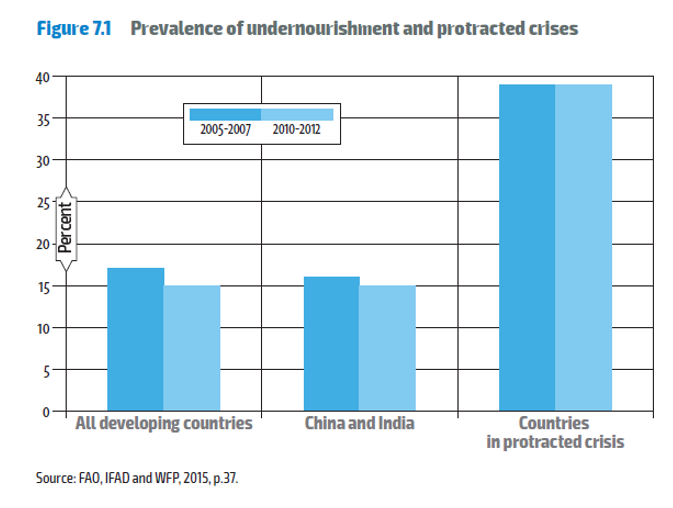
3 On average, the proportion of undernourished people living in low-income countries with a protracted crisis is between 2.5 and 3 times higher than in other low-income countries (Figure 7.1). In 2013, around 172 million people in countries with protracted crisis were undernourished – roughly 20 percent of the world’s undernourished people.
Of the 21 countries with protracted crisis in 2013, only Ethiopia reached the Millennium Development Goal (MDG) target of halving the proportion of undernourished in the population, largely due to sustained political commitment and interventions to improve food production and nutrition (FAO, IFAD and WFP, 2015). All other countries reported either insufficient progress or deterioration.
Recent conflicts, such as the ongoing civil war in the Syrian Arab Republic, a middle-income country, have led to massive displacement of people and widespread hunger and malnutrition. Of the estimated 13.5 million Syrians in need of humanitarian assistance, some 9.4 million, or more than half of the people remaining in the country, are food insecure. Compared to the pre-conflict averages, livestock numbers have been reduced by half and wheat production is down by 40 percent (FAO, 2016a), and is expected to deteriorate further. Similarly, in South Sudan, the livestock sector, a key livelihood source, lost an estimated US$2 billion in potential GDP during conflict in 2013–15 (FAO, 2016b).
Food insecurity and famine often cause more deaths than direct violence. Between 2007 and 2012 approximately 70 000 people a year lost their lives as a direct result of conflict or terrorism (GDAVD, 2015). In contrast, as a result of famine caused by prolonged drought and conflict, more than 250 000 people died in Somalia alone between October 2010 and April 2012 (FAO, 2013).
Most conflicts strike hardest in rural areas,4 with major adverse conse-quences for survival, agricultural production and rural livelihoods. Conflicts disrupt food production through the physical destruction and plundering of crops, livestock and food reserves. They discourage farming, disrupt food transportation systems, destroy farm assets and capital, force or entice young people to fight, and depress income-earning livelihoods and occupa-tions. They also cause psycho-social traumas and disabilities among survi-vors. There has been a reported rise in conflict-related sexual violence, with rape used as a weapon of war. As a result, survivors suffer from sexually transmitted diseases, stigmatization and trauma, which affects their health as well as productive capacities (UN Security Council, 2015).
In the medium- and longer-term, conflict directly and indirectly under-mines agricultural development. Between 1970 and 1997, agricultural losses for all low-income countries owing to conflict averaged US$4.3 billion annu-ally, far exceeding the value of development assistance to those countries (FAO, 2002). Similarly, the presence or risk of conflict discourages private investment in agriculture, even long after conflicts have ended.
The consequences of conflict, including the extreme measures necessary for survival, differ according to the age and gender of those affected. Power relations and social marginalization tend to be amplified as a result of the stressors, and the opportunities for exploitation, that arise during conflicts. The gender inequalities women and girls face limit their access to produc-tive resources, services, and decision-making processes. Thus their relative lack of equality, the burdens they carry as caregivers, their central role in food production, and other responsibilities expose them to particularly vulnerable situations.
Recruitment into fighting forces drains key sources of labour, especially men and boys, for agriculture production. This problem is exacerbated over the long term by war-related disabilities, with the consequent increase in the workloads of women and the elderly in carrying forward the agri-culture sector. Rural women take up new economic roles during conflict situations, while their domestic burdens increase (UN Women, 2012; CARE, 2016; Thulstrup and Henry, 2014). The enduring impact of conflicts is also manifested through an increase in the prevalence of malnutrition, espe-cially undernutrition during early childhood, with many of those affected suffering from lifelong physical and mental handicaps.
A worrying trend is that the impacts of conflict-induced food insecurity are no longer limited to specific countries or regions, but have become global. In 2015, more than 65 million people worldwide were forcibly displaced, the highest number since the end of the Second World War. Forced displacement is a crisis affecting mainly low-income countries, which host 89 percent of refugees and 99 percent of internally displaced persons. At its root are the same 10 conflicts that every year since 1991 have accounted for the majority of forcibly displaced people, who are consistently hosted by about 15 countries and who are overwhelmingly in the developing world (World Bank, 2016).
The effects of today’s conflicts are increasingly echoed across the broader global landscape as conflict-affected people migrate across coun-tries, regions and continents in search of security. There is a deepening awareness of how food insecurity in one part of the world can influence social services, political systems and national security elsewhere.
Agriculture is affected by a rising trend in the number and intensity of natural disasters worldwide
The vulnerability and exposure of individuals and their communities to the impacts of natural disasters depends on a range of factors, including gender, age, socio-economic status and ethnicity (IPCC, 2012). The impacts are often different for men and women, primarily because of gender-determined socio-economic status. A 2007 study conducted by London School of Economics, using a sample of 141 countries over the period 1981–2002, found that, on average, natural disasters and their subsequent impacts cause the deaths of more women than men, and kill women at an earlier age than men (Neumayer and Plümper, 2007).
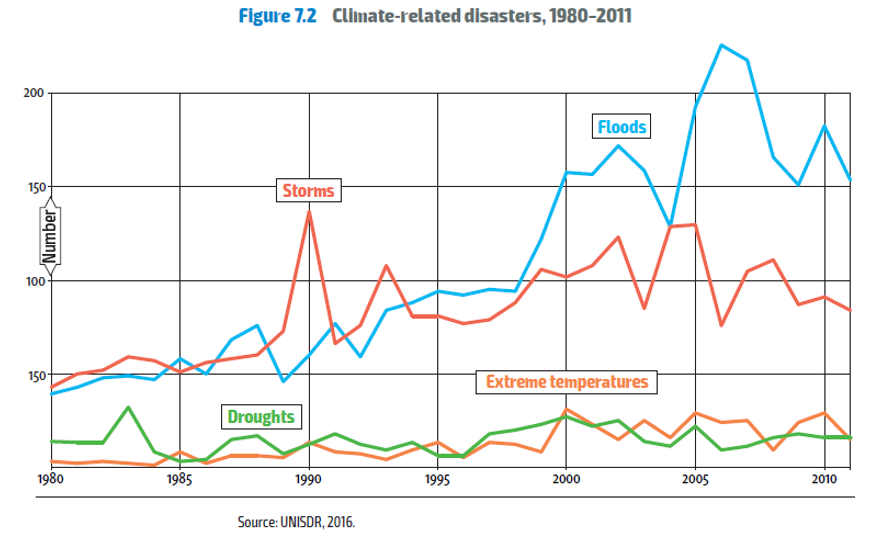
The past 30 years has seen a rising trend in the occurrence of natural disasters (Figure 7.2). This increase is particularly noteworthy in clima-tological events such as droughts, hydrological events such as floods, and meteorological events such as storms. The increase in weather-related events is of significant concern to agriculture, given the sector’s dependence on climate. The intensity of these disasters is increasing, and it may continue to increase as climate changes. For some regions, climate change will result in more intense precipitation, leading to more floods, longer dry periods between rain events, leading to more drought. Droughts are expected to intensify, especially in the subtropics and low- and mid-range latitudes.
The 2015/16 El Niño phenomenon was one of the strongest observed over the last 50 years, and its impacts were felt worldwide. Several severe tropical cyclones affected the Pacific Islands and Southeast Asian countries throughout the 2015/16 cyclone season. The year 2015 was the hottest on record, with the average global temperature much higher than in 2014, which itself was a record. New records are being set in 2016, with July being the hottest ever recorded (Earth Observatory, 2016).
An FAO report on the impact of disasters on agriculture and food security showed that, between 2003 and 2013, the agriculture sector in low-income countries absorbed 22 percent of the impact of natural disas-ters, including total economic damage to physical assets and infrastructure as well as losses due to changes in economic flows. Agriculture’s share rose to 25 percent when only climate-related disasters are considered, and up to 84 percent in the case of drought. Production losses suffered by producers in the aftermath of a disaster were twice as high as the direct damage to agricultural assets and infrastructure (FAO, 2015).
Agriculture subsectors can be affected differently by natural hazards and disasters. Crops tend to be most affected by floods and storms; live-stock is overwhelmingly affected by drought; the fisheries subsector is most affected by tsunamis and storms such as hurricanes and cyclones, while most of the economic impact on forestry is caused by floods, storms and wild fires.
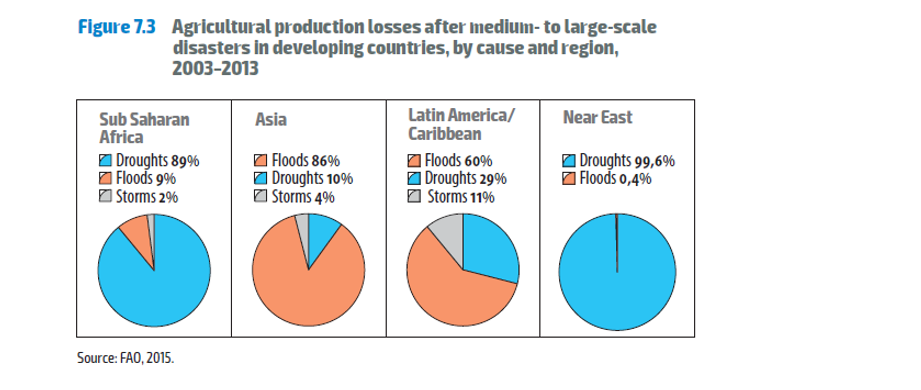
At the regional level, the types of natural disasters and their impacts on crop and livestock production, reflect differences in climate risks and vulnerabilities. Between 2003 and 2013, drought wreaked the greatest harm on agriculture in sub-Saharan Africa and the Near East; agriculture in Asia was mainly affected by floods; in Latin America and Caribbean, countries were affected mostly by floods, and to a lesser extent by droughts and storms (Figure 7.3).
Food insecurity and the scale of natural hazards reinforce one another. Disasters can have devastating impacts on food security, and food insecurity increases the impact of disasters. This creates a downward spiral in which affected people lurch from one crisis or disaster to the next. To address immediate needs, food insecure people may find themselves forced to take desperate measures, which often compromise their livelihoods, health and dignity, and increase further their vulnerability and exposure to disasters. At the same time, the most vulnerable low-income countries are the ones particularly exposed to the risk of food insecurity and malnutrition resulting from natural disasters.
Natural disasters disrupt agricultural production, ecosystems and live-lihoods, affecting the income of farmers and farm labourers. They lower the availability of food commodities in local markets, which leads to food price inflation. These pressures reduce households’ purchasing capacity, restrict access to food, deplete savings, force the sale of vital productive assets and erode livelihoods. Ultimately, the quantity and quality of food consumption are reduced, and food insecurity and malnutrition increase, particularly among the most vulnerable households. For instance, the 2010 floods in Pakistan affected 4.5 million workers, two-thirds of whom were employe
- For example, von Uexküll et al., 2016.
in agriculture; more than 70 percent of farmers lost more than half of their expected income (ADB, Government of Pakistan and World Bank, 2010).
There is greater awareness today of the need to reduce and manage disaster risks, particularly in countries facing recurrent disasters and where agriculture is a critical source of livelihoods, food security and nutrition, and a key driver of economic growth. Failure to embed disaster risk reduction (DRR) and disaster risk management (DRM) in development plans and related investments leads to ineffective interventions. As climate change intensifies risks from extreme weather events, DRR needs to be made an urgent priority in these countries if the world is to achieve the Sustainable Development Goals.
The lack of disaster risk planning is a missed opportunity. It has been estimated that emergency aid after a disaster exceeds investments in disaster prevention by almost 7 700 percent (ODI, 2016). DRR is also an entry point for climate change adaptation and resilience building. Opportunities for climate financing need to be created at the national level to establish strong linkages between DRR, climate change adaptation and resilience programming.
Challenges arise when dealing with natural hazards and the impacts of disasters owing to gaps in the availability of, and access to, data and information, including those that are gender-disaggregated. There is no single, harmonized methodology available for collecting data on the causes and impacts of natural disasters specifically in the agriculture sector. Data collection, monitoring and reporting on impacts at the subnational and national level need to be improved and harmonized across countries, to better inform sustainable development planning.
Trends indicate that natural hazards, disasters and conflict are more likely to coincide in the future
A number of high-profile disasters in fragile and conflict-affected states have focused attention on the concurrence of natural disasters and conflict, and their combined impact on food security and nutrition. There is an expectation that disasters and conflict will coincide more in the future. Climate change, continued urbanization, food price fluctuations, financial shocks and other stresses may all shape – and complicate – future trends at the disaster/conflict interface and negatively impact food security, nutrition outcomes and overall development.
Extreme weather events related to climate change, which contribute to conflict risks and associated pressure on populations to migrate, are expected to exacerbate a deepening global need for humanitarian assistance. Climate change
per se is not necessarily associated with violence. However, the intersection between vulnerability to climate change and broader insti-tutional and socio-economic fragility can increase the potential for conflict. New research is identifying relationships between adverse climatic events in agriculturally dependent and politically excluded groups in very poor countries, and increases in the likelihood of sustained violence.
5 This new trend, termed the ‘climate-conflict nexus’, is the intersection between weak institutions, pre-existing social fragility and climate change vulnerability (OCHA, 2016a).
Similarly, more than 75 percent of the world’s poor directly depend on natural resources for their livelihoods. Many may be forced to migrate as a result of the adverse impacts of climate change, with the most widely quoted estimate being 200 million environmental migrants by 2050 (Stern, ed., 2006). A growing number of interrelated, longer-term trends – such as urbanization, rural transformation, resource availability, agricultural productivity, price fluctuations, financial shocks and food insecurity – may impact, or be impacted by, the prevalence of conflict. Where urban and rural institutions are not equipped to manage fluctuating populations along with the allocation of resources and the provision of services, the potential for conflict can increase.
Addressing these emerging challenges calls for prevention through equity, stability and peace building. The Millennium Development Goals neither explicitly nor adequately addressed the rising trend in conflict worldwide. The 2030 Agenda for Sustainable Development does so, by calling for more collaborative approaches to conflict prevention, mitigation, resolution and recovery. It recognizes that peace is a vital threshold condition for develop-ment, as well as a development outcome in its own right.
Fostering human rights and greater equity within and between coun-tries is the key to preventing conflicts. Equity in economic development and good governance help address the root causes of violence. The UN system is moving toward an integrated and coherent approach to preventing armed conflicts and crises, predicated on reducing risk, building resilience and sustaining peace. Sustaining peace is expected to be clearly embedded in the 2016 quadrennial comprehensive policy review of the United Nations system. It is important to recognize, however, that conflict-sensitive approaches are needed not only for humanitarian assistance and building resilience, but especially for development support.
Source :FAO. 2017. The future of food and agriculture – Trends and challenges. Rome.


.png)


.jpg)


Share Your Comments
Only members can comment, Click here to sign up for free right now